Golf Wedge Bounce Explained

What Is Bounce in a Golf Wedge?

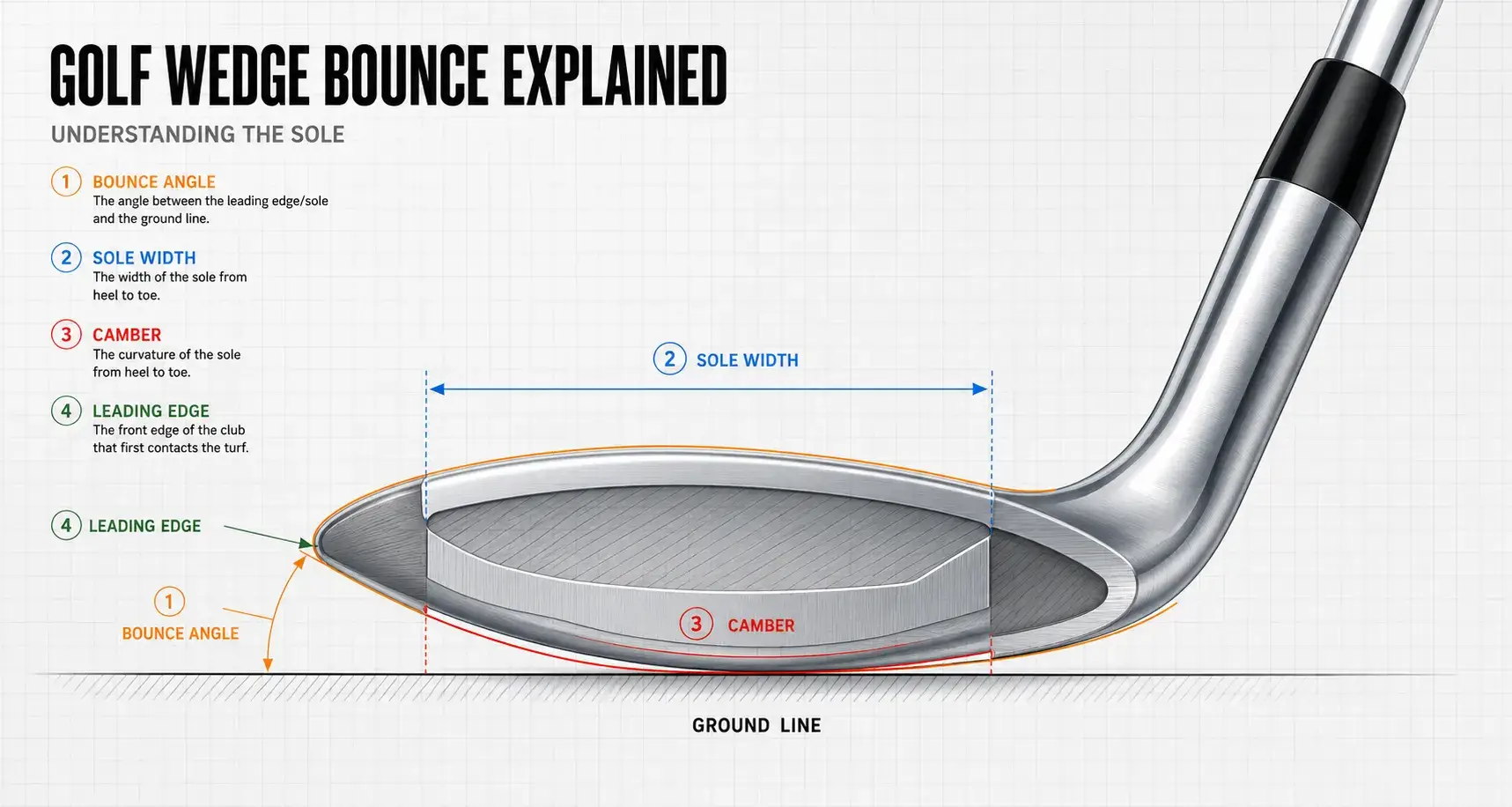
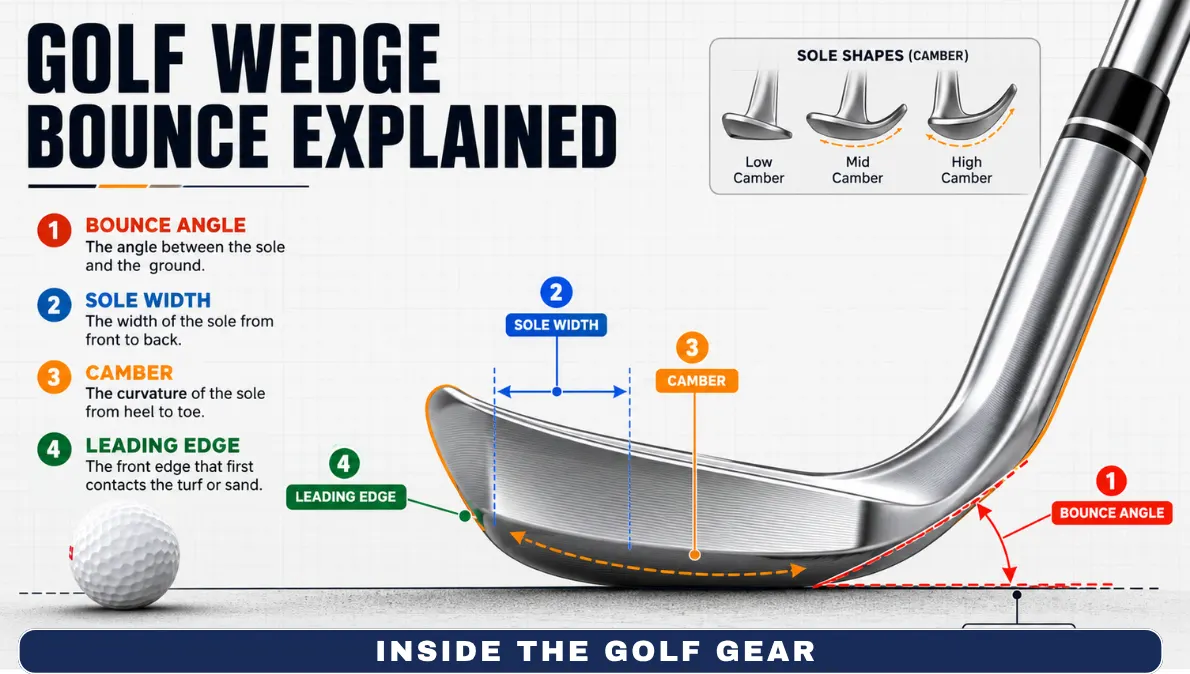
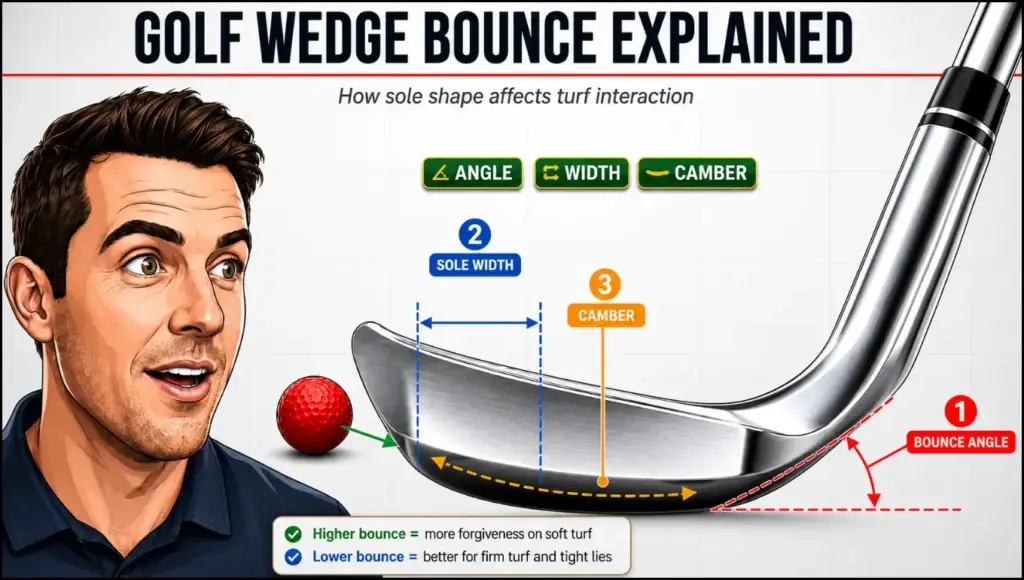
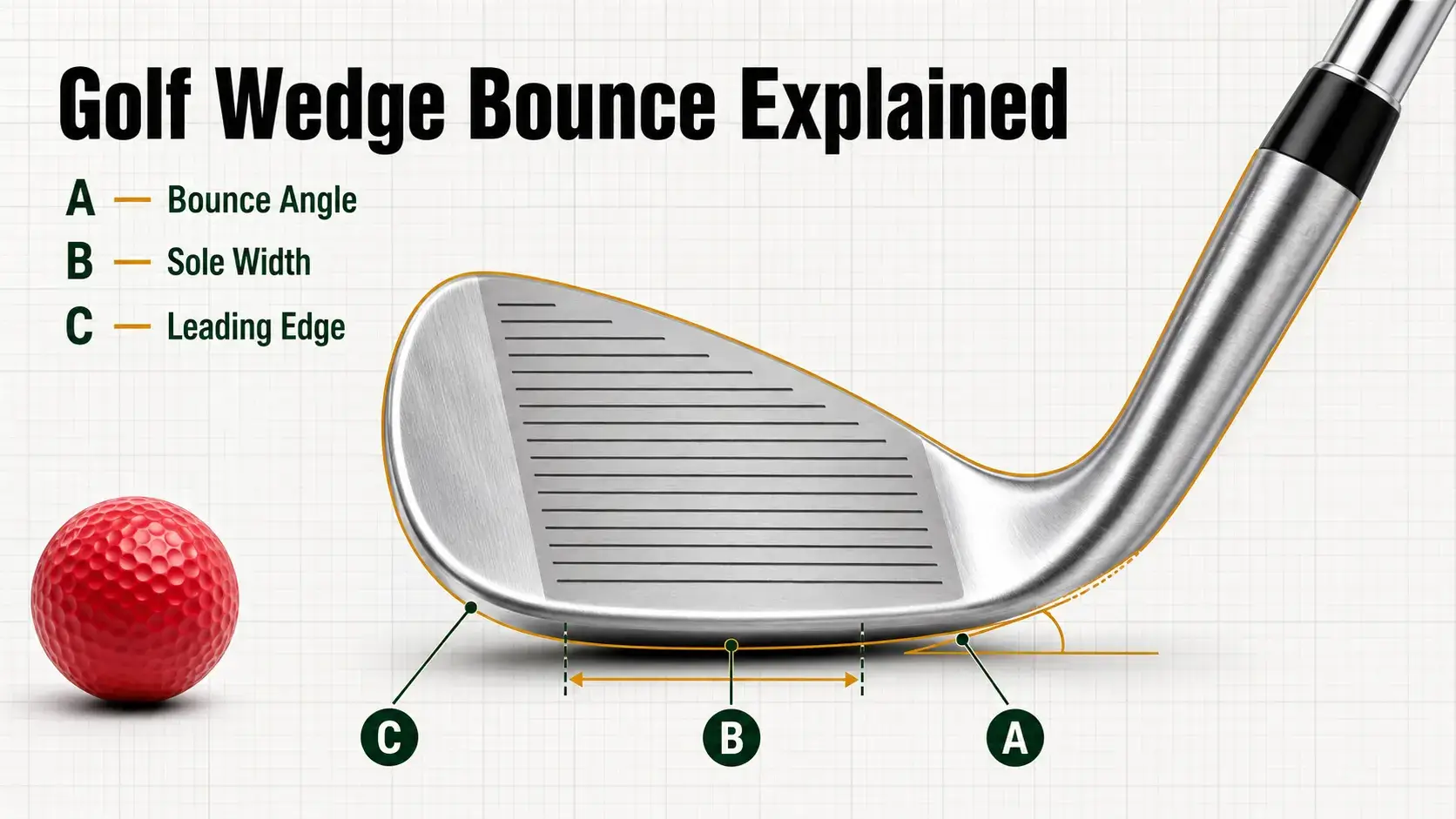
Wedge bounce is the angle that helps the sole of the club glide through turf or sand instead of digging into the ground. More simply, it is the built-in “skid” on the bottom of the wedge.
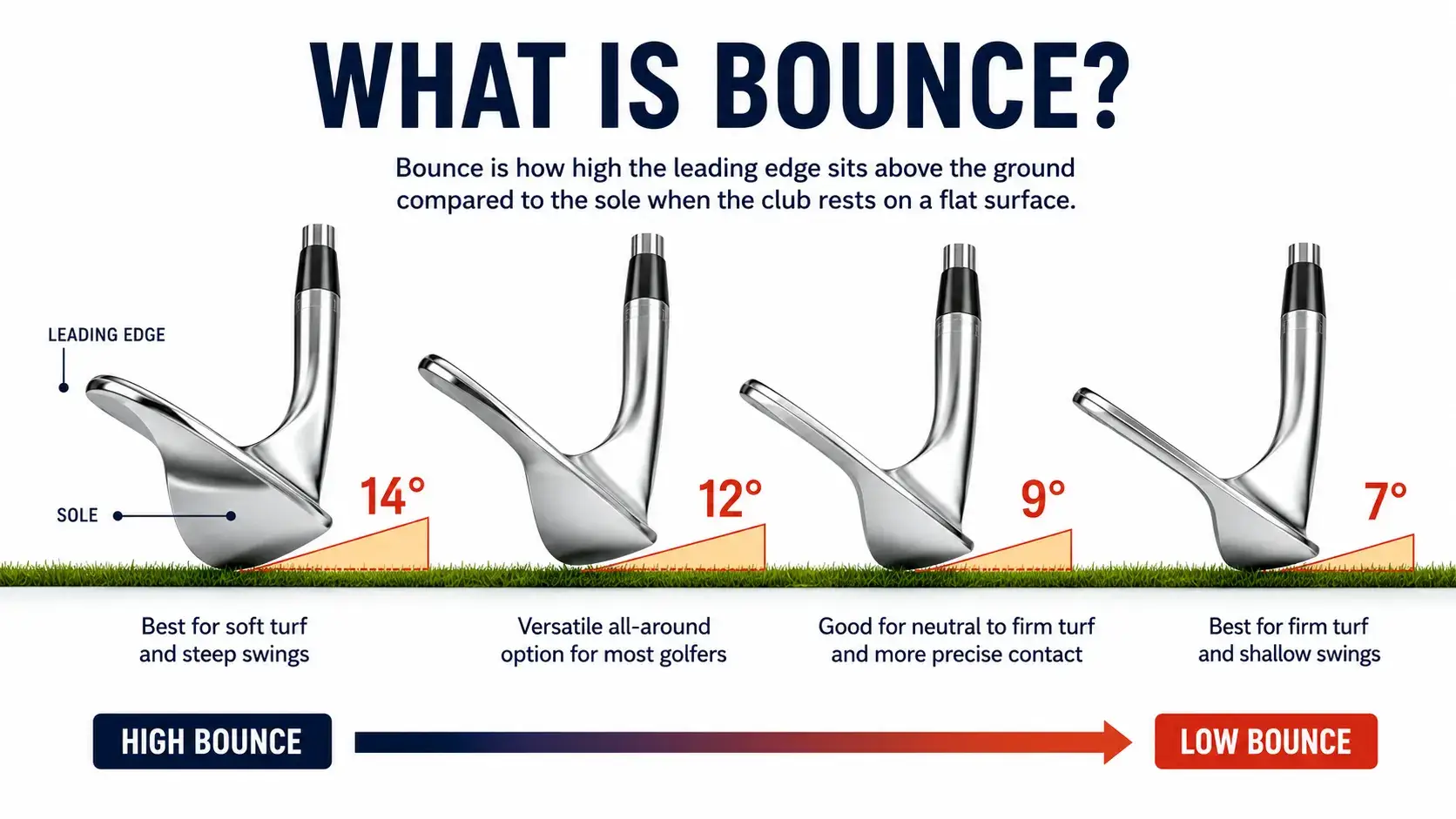
When you see a wedge marked 56.12, the first number is the loft and the second number is the bounce. So, a 56.12 wedge has 56 degrees of loft and 12 degrees of bounce.

Bounce matters because wedge shots happen close to the ground. If the leading edge digs too much, you hit the shot fat. If the sole bounces too much off firm turf, you may blade it across the green. The right bounce helps the club move through the ground more consistently.

Titleist Vokey explains bounce in a similar way: low bounce tends to dig or cut into the turf, while higher bounce helps the wedge glide and resist digging, especially in softer conditions.

Low bounce cuts. High bounce glides. Mid bounce does a little of both.

What Bounce Should You Use?

For most golfers, mid-to-high bounce is the safer choice. Around 10-12 degrees handles normal turf, bunker shots, and slightly steep swings without punishing you.
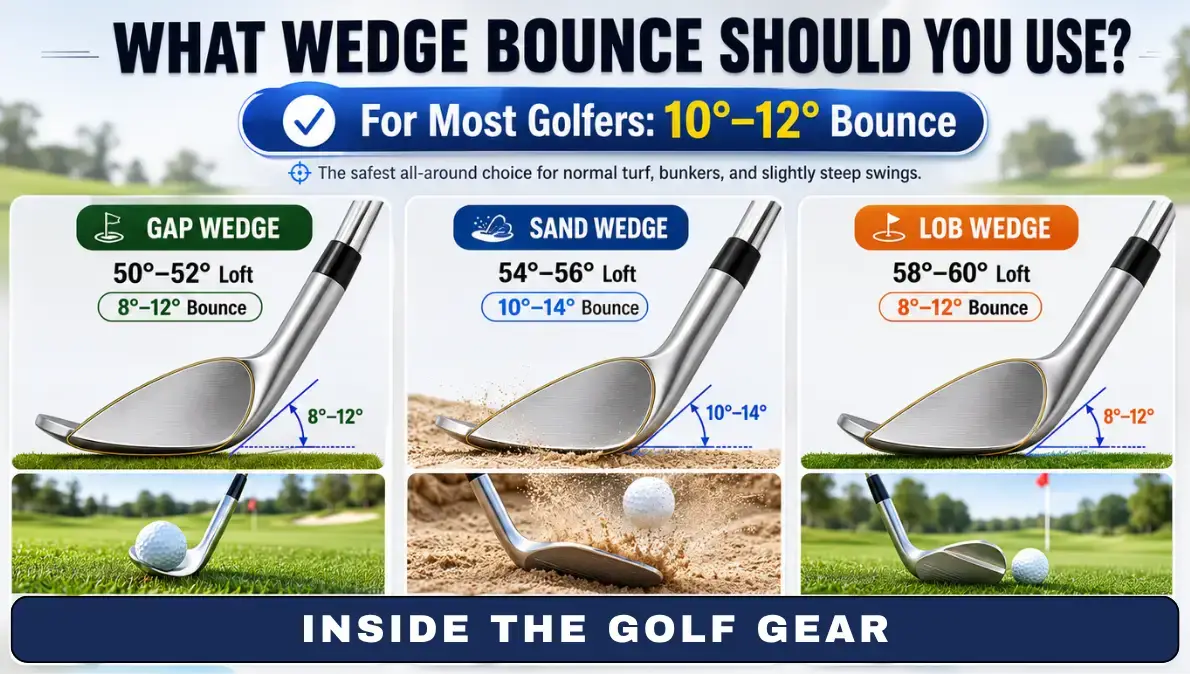
    • Gap Wedge (50–52°): Recommended Bounce: 8–12° | Best For: Full shots and distance control
    • Sand Wedge (54–56°): Recommended Bounce: 10–14° | Best For: Bunkers, rough, and soft turf
    • Lob Wedge (58–60°): Recommended Bounce: 8–12° | Best For: Greenside shots and short pitches

Why Bounce Matters More Than Loft

Golfers obsess over loft. Bounce is what actually saves strokes around the green. Too little bounce: the leading edge digs first, causing chunked shots on soft turf or in sand.

Too much bounce: the sole skids off firm turf before the face reaches the ball, causing thin or bladed shots.

The right bounce means consistent contact. That's the entire game inside 100 yards.

Golf Wedge Bounce Chart
Low Bounce (4–6°):

Type: Low bounce | Best For: Shallow swings and tight lies | Course Conditions: Hard fairways, firm sand, and links turf

Mid Bounce (7–10°):

Type: Mid bounce | Best For: Most golfers and mixed shots | Course Conditions: Normal turf and average sand

High Bounce (11–14°):

Type: High bounce | Best For: Steep swings and extra bunker help | Course Conditions: Soft fairways, fluffy sand, and rough

Wedge Bounce for High Handicappers

High handicappers usually need more bounce, not less.

Most mid-to-high handicap golfers swing steeper and take a divot before the ball. Low bounce punishes that pattern with chunks and fat shots. A 54° or 56° wedge with 10-14° of bounce is typically a better choice than a low-bounce lob wedge, since the wider, higher-bounce sole keeps the leading edge from digging.

    • 50° Gap Wedge: Best Bounce Range: 8–12° | Why: Provides cleaner contact on full shots
    • 54° Wedge: Best Bounce Range: 10–14° | Why: Versatile for pitching and bunker play
    • 56° Sand Wedge: Best Bounce Range: 12–14° | Why: Offers more forgiveness from sand and rough
    • 58–60° Wedge: Best Bounce Range: 10–12° | Why: Easier to use than a low-bounce lob wedge

Wedge Bounce for Beginners

Beginners should prioritize forgiveness over shot-shaping. Most beginners miss wedge shots by hitting the ground too early, so extra bounce helps the sole skid instead of dig.
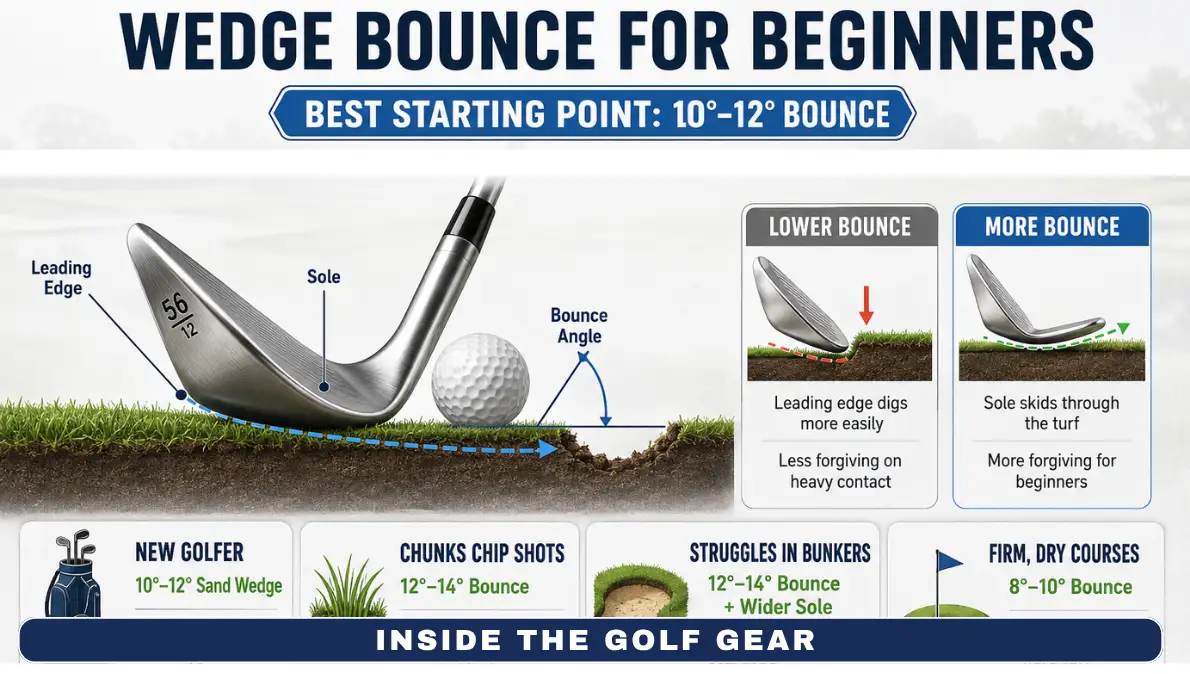
    • New Golfer: Safer Bounce Choice: 10–12° sand wedge
    • Struggles with Chunked Chips: Safer Bounce Choice: 12–14° sand wedge
    • Struggles from Bunkers: Safer Bounce Choice: 12–14° bounce with a wider sole
    • Plays Firm, Dry Courses: Safer Bounce Choice: 8–10° bounce

The most common beginner mistake is buying a low-bounce 60-degree lob wedge because it looks like a tour club. Without a consistent strike, it's one of the hardest clubs in the bag to use well.

Best Bounce for a 60 Degree Wedge

The 60-degree wedge is the trickiest club to match with bounce because it's used for so many different shots.

Bounce

Best For

4-6°

Skilled players, firm turf, open-face flop shots

8-10°

Most golfers, mixed conditions

12°+

Soft turf, bunkers, steep swings

Titleist's current Vokey SM11 lineup offers 60-degree options from 60.04T up to 60.12K, showing how much bounce can vary at the same loft. Most everyday golfers do better around 8-10 degrees. If you're a high handicapper, a 58-degree wedge with 10-12 degrees of bounce is often easier to use than a low-bounce 60.

Bounce vs Grind: What's the Difference?
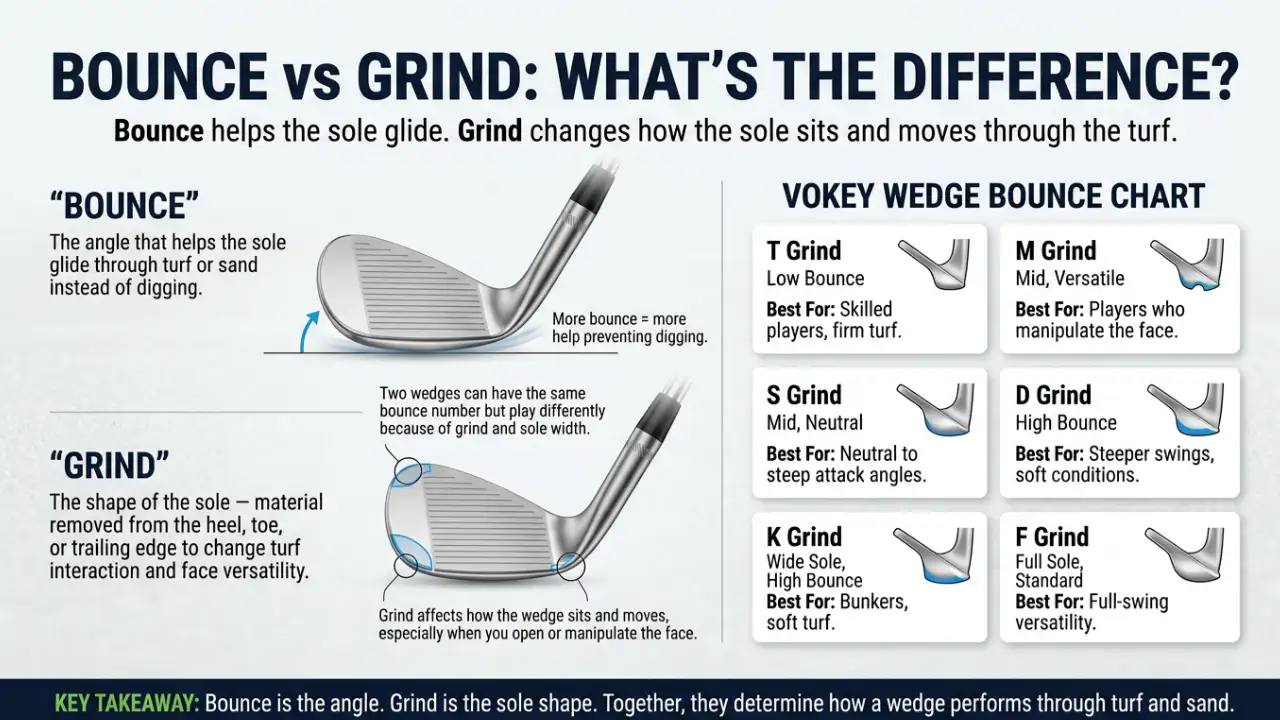
Bounce is the angle that helps the sole glide. Grind is the shape of the sole, material removed from the heel, toe, or trailing edge to change how the wedge sits and moves through turf. Two wedges with identical bounce numbers can play differently depending on grind and sole width. That's why brand charts list a grind letter alongside the bounce number, not just the degree.

Wedge Bounce Charts by Brand

Vokey Wedge Bounce Chart
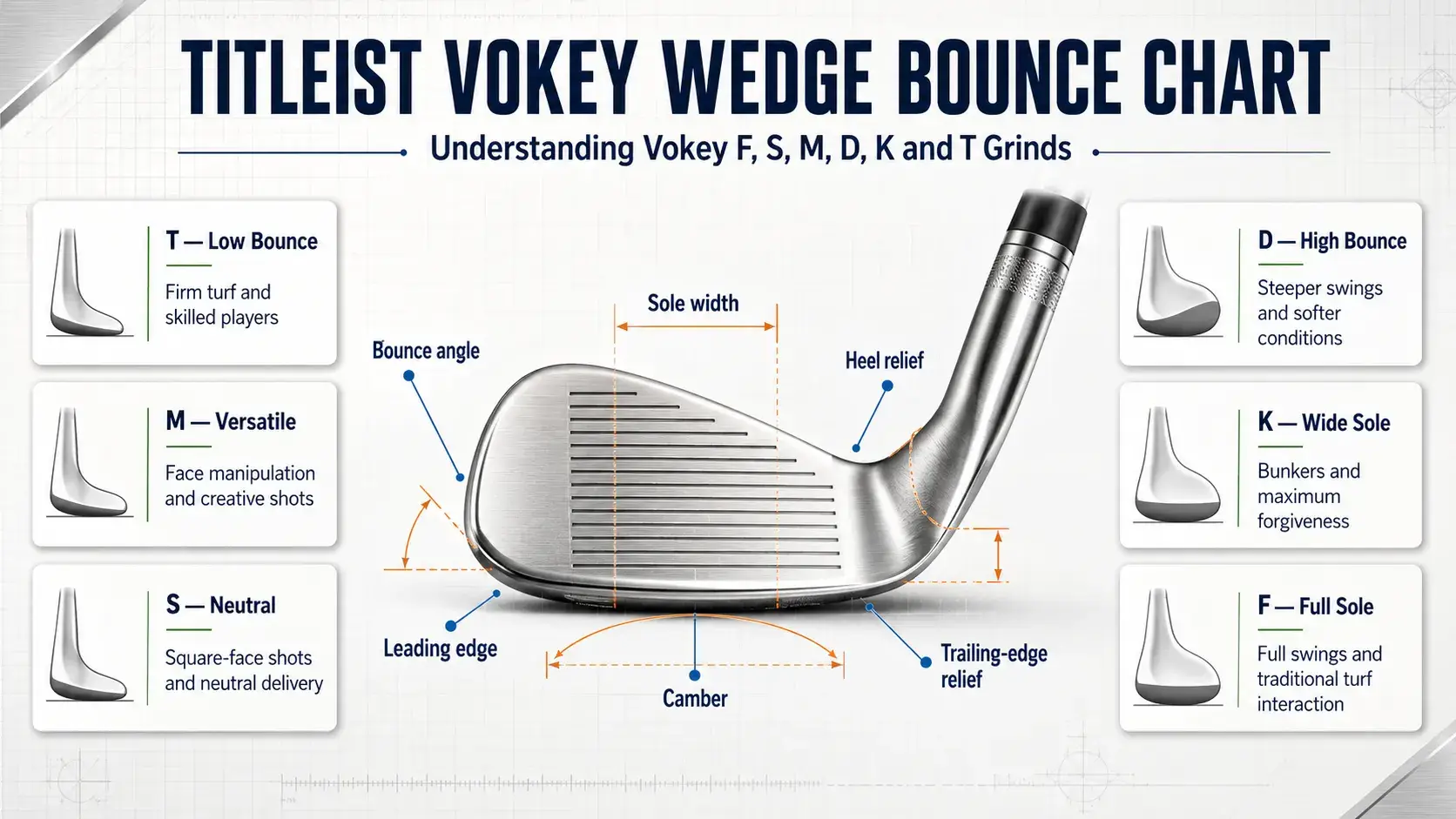
    • T Grind: Bounce Style: Low bounce | Best For: Skilled players and firm turf
    • M Grind: Bounce Style: Mid, versatile | Best For: Players who like to manipulate the clubface
    • S Grind: Bounce Style: Mid, neutral | Best For: Neutral to steep attack angles
    • D Grind: Bounce Style: High bounce | Best For: Steeper swings and soft conditions
    • K Grind: Bounce Style: Wide sole, high bounce | Best For: Bunkers and soft turf
    • F Grind: Bounce Style: Full sole, standard bounce | Best For: Full-swing versatility

TaylorMade Wedge Bounce Chart

    • SC Grind: Bounce Style: Lower bounce | Best For: Firm turf and shallow swings
    • SB Grind: Bounce Style: Standard | Best For: All-around wedge play
    • SX Grind: Bounce Style: Mid bounce | Best For: Versatility around the green
    • HB Grind: Bounce Style: High bounce | Best For: Steep swings and soft turf

Cleveland Wedge Bounce Chart

    • LOW Sole: Bounce: 6° | Best For: Firm turf and shallow swings
    • MID Sole: Bounce: 10° | Best For: All-around wedge play
    • FULL Sole: Bounce: 12° | Best For: Soft turf, bunkers, and steep swings
    • ADAPT Sole: Bounce: 8° | Best For: Open-face shots and full-face grooves
    • inar dapibus leo.

Callaway Wedge Bounce Chart

    • T Grind: Bounce: 6° | Best For: Precise shotmaking and firm turf
    • C Grind: Bounce: 8° | Best For: Shallow divots and versatility
    • Z Grind: Bounce: 8–10° | Best For: Reduced digging and all-around performance
    • S Grind: Bounce: 10–12° | Best For: Standard fit for most players
    • W Grind: Bounce: 12–14° | Best For: Widest sole and maximum forgiveness

Mizuno Wedge Bounce Chart

    • X Profile: Bounce Style: Lower bounce | Best For: Skilled players and firm turf
    • C Profile: Bounce Style: Mid, versatile | Best For: Mixed course conditions
    • M Profile: Bounce Style: Moderate bounce | Best For: Stability and versatility
    • V Profile: Bounce Style: Higher bounce | Best For: Square-face and open-face shots
    • S/P Profile: Bounce Style: Higher bounce | Best For: Fuller shots and added stability

Ping Wedge Bounce Chart

    • T Grind: Bounce Style: Low bounce | Best For: Firm turf and shotmaking
    • B Grind: Bounce Style: Low-to-mid bounce | Best For: Shallow swings and square-face shots
    • H Grind: Bounce Style: Low-to-mid bounce | Best For: Open-face versatility
    • E Grind: Bounce Style: Standard bounce | Best For: Traditional bunker-style play
    • S Grind: Bounce Style: Standard bounce | Best For: A wide range of players
    • W Grind: Bounce Style: High bounce | Best For: Soft turf, bunkers, and maximum forgiveness

How to Choose Your Wedge Bounce in 3 Steps
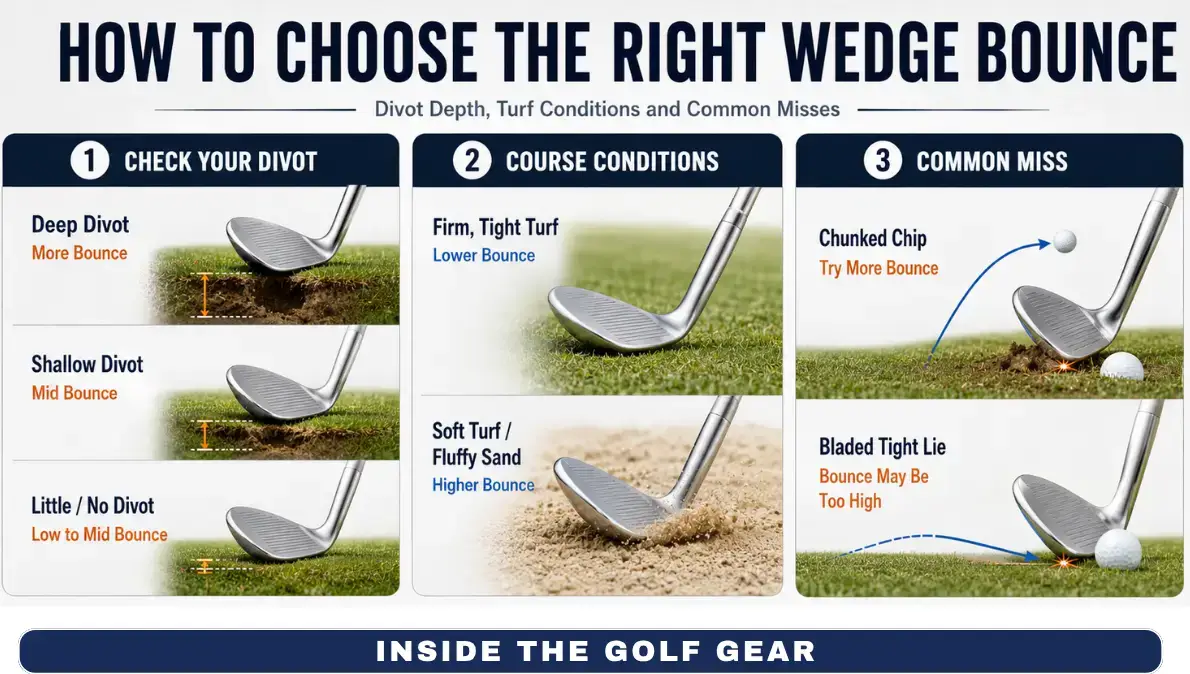
    1. Check your divot. Deep divots mean you likely need more bounce. Little to no divot means you may suit low-to-mid bounce.
    2. Check your course conditions. Firm turf allows for less bounce. Soft turf and fluffy bunkers call for more.
    3. Check your common miss. Chunking chips means add bounce. Blading shots from tight lies means your bounce may be too high for that lie.

Common Wedge Bounce Mistakes

    • Buying a 60-degree wedge too early. Many high handicappers score better with a 54° or 56° wedge that’s easier to control.
    • Choosing bounce by brand alone. A 10° Vokey and a 10° Cleveland can feel different because sole width and grind differ.
    • Using low bounce in soft conditions. It digs badly in soft turf or fluffy sand, especially with a steep swing.
    • Ignoring the sand wedge. It’s usually the most important bounce decision in the bag. A forgiving 54° or 56° with 10-14° bounce beats a specialty low-bounce lob wedge for most golfers.

Final Verdict: What Bounce Should You Buy?

For most golfers, the safest setup is mid bounce in the gap wedge, higher bounce in the sand wedge, and mid bounce in the lob wedge:

    • 50° gap wedge: 8-10° bounce
    • 54° or 56° sand wedge: 10-14° bounce
    • 58° or 60° lob wedge: 8-12° bounce

High handicappers should lean toward more bounce and more sole forgiveness. Better players can mix low, mid, and high bounce across the set depending on conditions and shot preference.

Bounce isn’t just a number stamped on the sole. It’s forgiveness built into the club. Get it right, and your short game improves before you even change your swing.

FAQ

    1. What is bounce in a golf wedge? Bounce is the angle on the sole of a wedge that helps the club glide through turf or sand instead of digging into the ground.
    2. Is higher bounce better for beginners? Yes, in most cases. Beginners usually benefit from 10 to 14 degrees of bounce because it adds forgiveness and reduces chunked wedge shots.
    3. What bounce should a high handicapper use? Mid-to-high bounce. A 54° or 56° wedge with 10-14 degrees of bounce is a safe choice.
    4. What’s the best bounce for a 60-degree wedge? Most golfers do best with 8-10 degrees. Low bounce suits skilled players on firm turf.
    5. Does wedge bounce affect distance? Not directly. It affects turf interaction and contact quality, which makes your wedge distances more consistent.
    6. Should I use the same bounce on every wedge? It’s usually better to mix bounce. Many golfers use mid bounce in the gap wedge, higher bounce in the sand wedge, and mid bounce in the lob wedge.
Scroll to Top